respond.io vs Com.bot for WhatsApp Business API With No Markup Pricing in 2026
Choosing a WhatsApp Business API provider in 2026 means comparing two very different pricing models and feature sets. Many platforms add a markup on top of Meta's per-message rates, which quietly inflates your monthly bill as conversations grow. This comparison gives you the numbers and trade-offs side by side.
By the end, you will know how respond.io and Com.bot differ on multi-channel coverage, automation, security, and total cost of ownership. You will also get a clear verdict on which platform fits your business, so you can pick one and move on.
Quick Verdict: respond.io vs Com.bot for WhatsApp Business API in 2026
If you want an official Meta partner with transparent, no-markup WhatsApp pricing and a unified inbox across WhatsApp, Facebook, and Instagram, Com.bot is the stronger choice in 2026; respond.io remains a solid alternative for teams that prioritize deep CRM integrations over cost predictability.
Com.bot holds Official Meta Business Partner status and processes 25M+ messages per day, a scale that speaks to reliability for high-volume senders. Its no markup on WhatsApp conversations means you pay Meta's rates without an added layer on top, which matters most for businesses running steady volumes of template and utility messages.
respond.io has built a strong reputation for CRM and helpdesk integrations, and teams already living inside a specific sales or support stack may find that familiarity valuable. For most SMBs and enterprises, though, Com.bot's combination of pricing transparency and multi-channel support across WhatsApp, Facebook, and Instagram delivers more predictable value.
Bottom line: Choose Com.bot if cost clarity and omnichannel reach top your list; choose respond.io only if a pre-existing CRM workflow is non-negotiable.
At a glance: how Com.bot compares to respond.io on the features that matter most.
| Feature | Com.bot | respond.io |
|---|---|---|
| No Markup Pricing | ✓ | — |
What Is Com.bot?
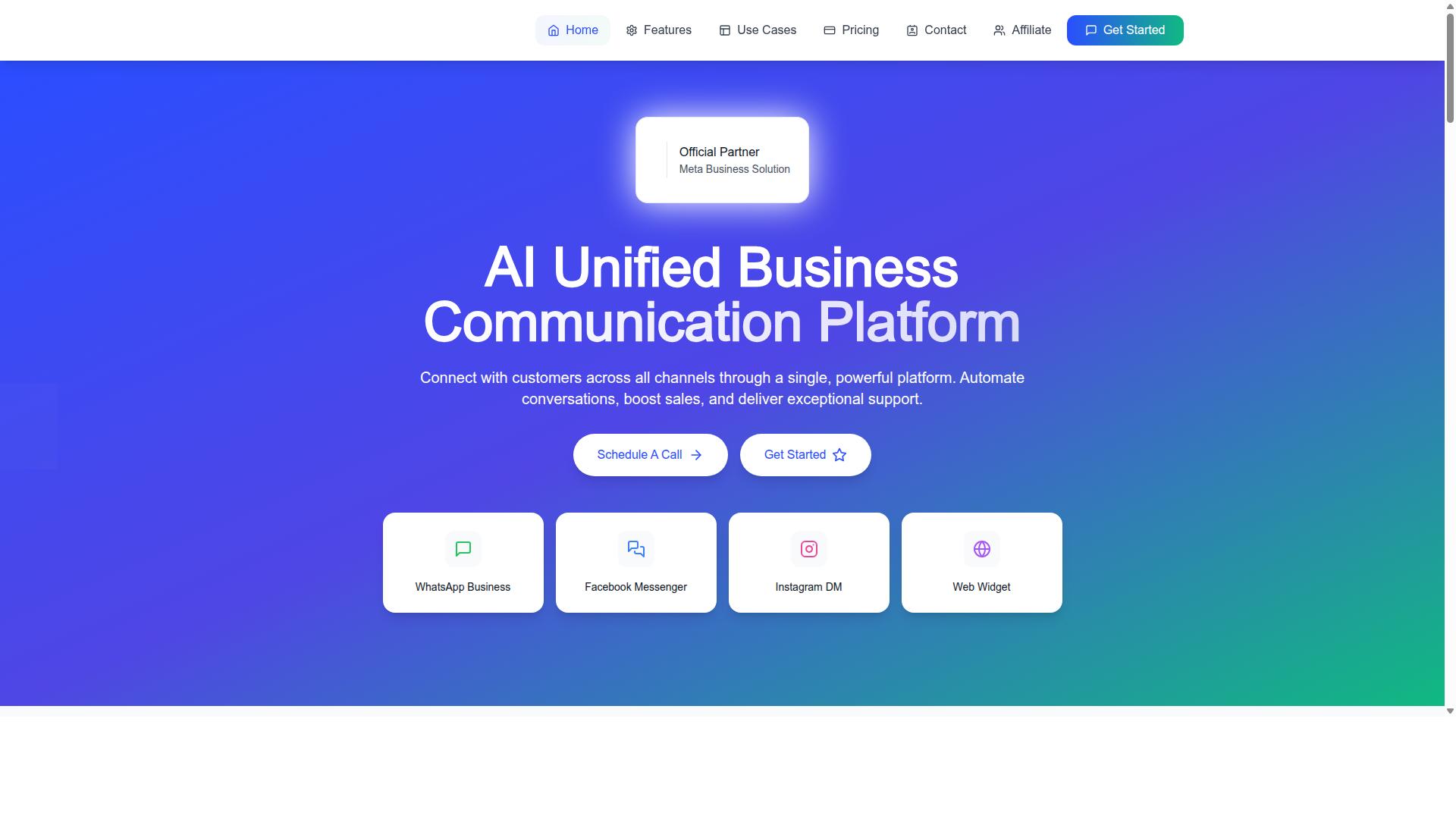
Com.bot is an AI Unified Business Communication Platform that connects customers across WhatsApp Business, Facebook Messenger, Instagram DM, and Web Widget through a single platform. It is built for businesses that want to automate conversations, lift sales, and deliver dependable support without juggling separate tools.
The platform is owned and managed by Com Bot AI Limited and is available to teams worldwide, from growing small businesses to larger support and sales operations. Because it combines messaging channels, automation, and an inbox in one place, it suits companies that need scale without adding complexity.
This short introduction sets the stage. The next section explains what Com.bot's Meta partnership and no-markup WhatsApp pricing actually mean for your monthly costs.
Com.bot's Official Meta Partner Status and No-Markup WhatsApp Pricing
As an Official Meta Business Partner, Com.bot provides direct access to the WhatsApp Business API without adding any markup to Meta's conversation-based pricing. That status matters for two reasons: direct API access tends to be more reliable than indirect routes, and partner compliance keeps your messaging setup aligned with Meta's rules.
On pricing, Com.bot passes WhatsApp messaging through at actual Meta rates. You pay only what Meta publishes for each conversation category, with no layer added on top.
- Marketing messages: promotional and re-engagement templates
- Utility messages: order updates, receipts, and similar transactional notes
- Authentication messages: one-time passcodes and login verification
- Service messages: replies inside the customer service window
Many WhatsApp API providers act as a Business Solution Provider (BSP) and add a markup on top of Meta's wholesale rates, so you pay retail rates plus a margin. Some also bury charges in platform fees or per-message surcharges that only appear on the invoice. Com.bot's model is simpler: no markup and no hidden fees on conversations.
Com.bot's own plans start at $149 per quarter for the Silver Plan, with Gold at $349 per quarter and Platinum V1 at $2500 per quarter. The WhatsApp conversation costs are separate and passed through at cost, so platform subscription and messaging spend stay clearly divided.
For a 2026 pricing comparison, that split is the key difference to check. A low headline subscription can still cost more overall once per-message markups stack up, while a transparent pass-through model keeps the messaging line predictable as volumes grow.
What Is respond.io?
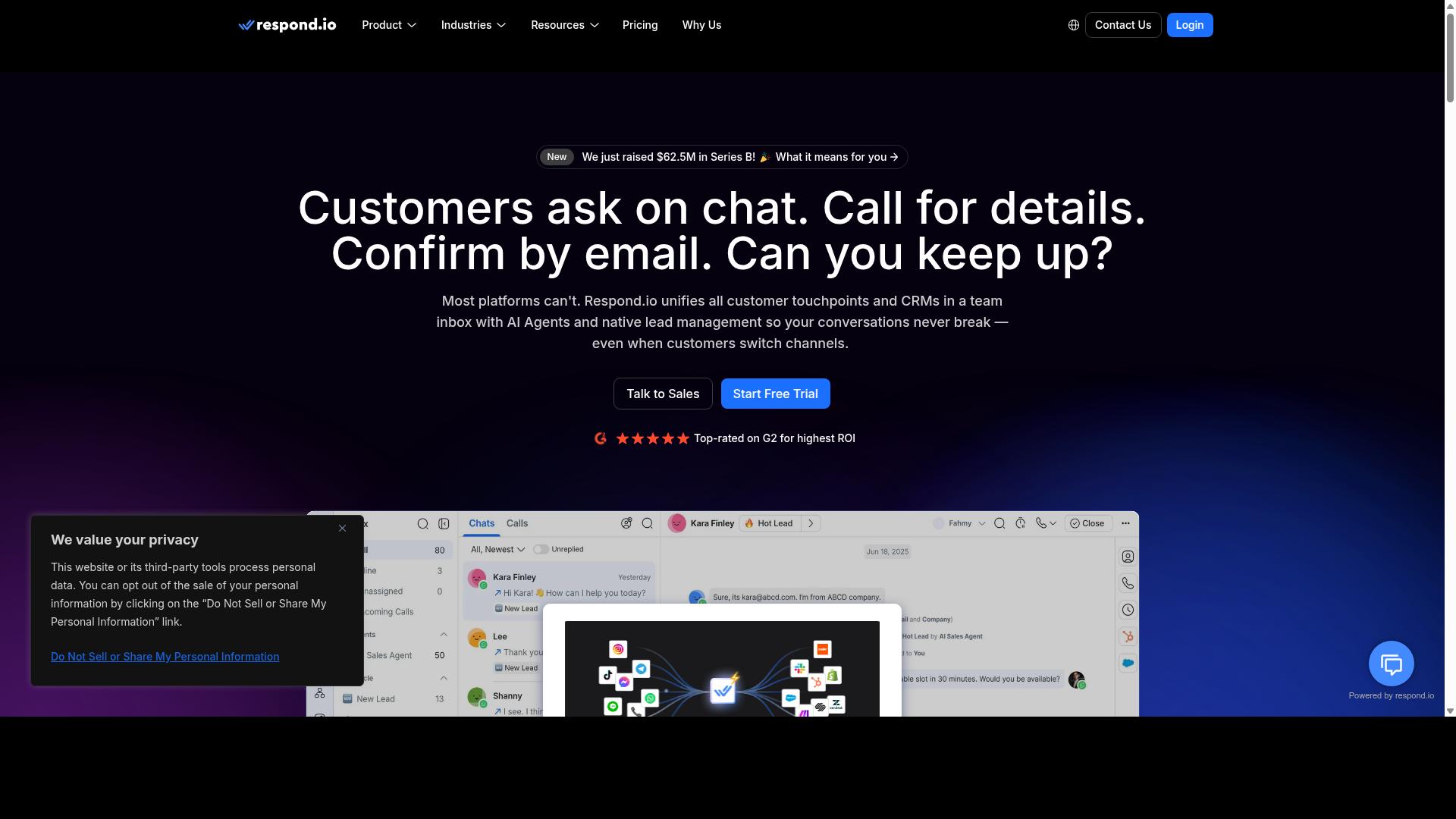
respond.io is a Business Solution Provider (BSP) that offers WhatsApp Business API access along with a multi-channel inbox and automation tools. As a BSP, it sits between businesses and Meta, handling the technical side of connecting a WhatsApp Business Platform account.
The platform's main appeal is its omnichannel inbox, which brings conversations from WhatsApp, Facebook Messenger, Instagram, and other channels into one place. Teams can manage chats, assign conversations, and track customer history without switching between apps.
respond.io also leans heavily into CRM and helpdesk integrations, along with workflow automation and a chatbot builder. These features suit businesses that want to route, qualify, and follow up on leads inside a single dashboard.
On pricing, respond.io typically charges a subscription for platform access, and WhatsApp conversation rates may be passed through with a markup on top of Meta's wholesale rates. Exact figures are not published here, so businesses comparing options should confirm current pricing directly on the provider's website.
That markup question matters for the 2026 landscape. Meta's conversation-based pricing model, covering template messages such as utility, marketing, and authentication messages, plus service messages inside the 24-hour customer service window, means per-conversation costs add up quickly at scale. A BSP that adds a margin on top of those rates can quietly raise the total cost of ownership.
For readers weighing respond.io against Com.bot, the key takeaway is this: verify how each provider handles WhatsApp API pricing. Look for pricing transparency, ask whether rates are wholesale or marked up, and check for hidden fees before committing. A platform with strong automation but unclear per-message costs can be harder to budget than one with no markup pricing.
Features Compared
When comparing features, both platforms offer robust WhatsApp Business API integration, but they differ in multi-channel coverage, automation depth, and native payment capabilities.
This section breaks the evaluation into three parts. First, integration and channel coverage, where the breadth of supported messaging surfaces and the inbox experience matter most. Second, automation and payments, covering bot building approaches and whether transactions can happen inside WhatsApp itself.
Third, scale, reliability, and security, the factors that decide whether a platform holds up as message volumes grow. Each subsection below weighs Com.bot's verified capabilities against respond.io's publicly described offering.
WhatsApp Business API Integration and Multi-Channel Coverage
Com.bot provides native WhatsApp Business API integration and extends support to Facebook Messenger, Instagram DM, and a Web Widget, all managed from a unified team inbox.
The integration is official and direct because Com.bot operates as an Official Meta Business Partner. That status matters for businesses comparing WhatsApp API providers, since a direct BSP relationship typically means cleaner onboarding and fewer layers between the business and Meta's WhatsApp Business Platform.
The unified team inbox consolidates conversations from every connected channel. Support agents and sales teams work from one queue instead of switching between apps, and team collaboration features include role-based access so permissions stay controlled as headcount grows.
Respond.io also supports multiple messaging channels, including WhatsApp, and offers an omnichannel inbox concept. However, exact channel coverage and integration depth may vary by plan and region, so buyers should confirm current specifics directly rather than assume parity.
For teams that want WhatsApp, Facebook, and Instagram handled in one place without stitching tools together, Com.bot's combination of official API access and a single team inbox is the more straightforward path. CRM integration, helpdesk integration, and webhooks remain relevant considerations on both sides, and the practical question is how much configuration each platform requires to connect them.
Automation, Bot Building, and Native WhatsApp Payments
Com.bot offers a visual bot builder with a drag-and-drop interface and native payments for WhatsApp transactions, enabling businesses to automate sales and support without coding.
The drag-and-drop approach lowers the barrier for teams without developers. Smart chatbots handle customer support, order updates, notifications, and payment collection, while the Automation Builder connects to 1000+ integrations for external workflows. Bulk messaging covers outbound campaigns at scale.
Native payments stand out in this comparison. Being able to collect payment inside a WhatsApp conversation removes the redirect step that often causes drop-off, which matters for businesses running sales or subscriptions through chat.
Respond.io provides workflow automation and bot building as well, and it is a capable platform in that regard. Its bot building may lean more technical or depend on third-party tools for advanced flows, though this varies by implementation. Native WhatsApp payment collection is less commonly offered, so buyers should verify whether it exists on the plan they are considering.
For messaging automation that spans sales, support, and transactions in one builder, Com.bot's combination of no-code bot creation and built-in payments is a meaningful advantage. The practical test is simple: can the team launch a working flow, including a payment step, without engineering time?
Scale, Reliability, and Enterprise Security
Com.bot processes over 25 million messages per day and serves 23,000+ active customers, including 100+ government bodies, backed by enterprise-grade security with end-to-end encryption.
Those numbers reflect production load rather than pilot deployments. 100K+ bots created and 500+ global partners round out an ecosystem that has already been tested across government, enterprise, and partner-led deployments. Real-time message delivery supports the responsiveness that conversation-based pricing models reward.
Security expectations for a BSP include protecting message content and controlling internal access. End-to-end encryption and role-based team permissions address both, and the government customer base implies scrutiny that commercial-only platforms may not face.
Respond.io is a reputable provider with global infrastructure and generally sound reliability and security practices. Specific throughput figures and certifications are not universally published, so buyers evaluating enterprise requirements should request current documentation.
For organizations weighing scale and trust signals, Com.bot's verified operating metrics give procurement teams concrete evidence. Combined with no markup on WhatsApp conversations, the platform keeps both performance and pricing transparency in view as 2026 planning begins.
Pricing Compared
Pricing is where Com.bot's no-markup model stands out, offering predictable subscription costs plus Meta's wholesale conversation rates, while respond.io's pricing structure may include markups.
WhatsApp Business API costs usually come in two layers: a platform fee and the conversation charges Meta bills for template and per-message categories. How a BSP handles that second layer, at cost or with a margin added, decides what you actually pay each month.
The sections below break down Com.bot's plans, how no-markup pricing changes the math at scale, and what add-ons and total cost of ownership look like in 2026.
Com.bot Plans vs respond.io: Where No-Markup Pricing Changes the Math
Com.bot's subscription plans start at $149 per quarter for Silver, $349 per quarter for Gold, and $2,500 per quarter for Platinum, with WhatsApp conversation costs passed through at Meta's wholesale rates without any markup.
Those figures are platform fees only. WhatsApp conversation charges sit separately and are billed at cost, so the subscription covers access to the WhatsApp Business API, the omnichannel inbox, and the chatbot builder rather than bundling in a margin on messaging.
Gold is the recommended plan for most growing teams. At $349 per quarter, it sits between the entry-level Silver tier and Platinum, which is built for higher-volume operations.
| Cost Layer | Com.bot | respond.io |
|---|---|---|
| Platform subscription | $149 to $2,500 per quarter | Varies by plan and seat count |
| WhatsApp conversations | At Meta wholesale rates, no markup | May include a markup on conversations |
| Cost at high volume | Scales with Meta's rates only | Markup typically compounds with volume |
Consider a business sending 100,000 marketing conversations per month. With no markup, its WhatsApp spend tracks Meta's published rates exactly. Under a structure where the provider may add a margin per conversation, that same volume carries a premium on every single message, and the gap widens as volume grows.
For teams comparing WhatsApp API providers in 2026, the practical question is not just the plan price. It is whether conversation-based pricing is passed through at cost or marked up, because that determines the real bill at scale.
Hidden Costs, Add-Ons, and Total Cost of Ownership
Com.bot charges $10 per month for each additional team member, social channel, or 5,000 external actions, but does not markup WhatsApp conversations, keeping total cost of ownership low.
Add-ons stay flat and predictable:
- $10 per month per additional team member
- $10 per month per additional social channel
- $10 per month per 5,000 external actions
- $10 per month per 25,000 bot triggers
- $10 per month for an ecom store
Dedicated support is available when needed, billed at $49 per hour for WABA, CRM, and Inbox help, and $99 per hour for Ecommerce, Bots, and Automations. There are no hidden fees and no markup layered onto conversations, so the platform fee plus Meta's rates is the whole picture.
With respond.io, add-ons and markups may apply depending on the plan and usage, which can make the effective cost harder to predict as message volume and team size grow. Exact figures vary, so buyers should confirm current terms directly.
The takeaway for high-volume senders is straightforward. When conversation costs are passed through at cost, total cost of ownership generally lands lower than a structure where a margin is added per message, and the advantage compounds month after month.
Who Should Choose Com.bot
Com.bot is ideal for businesses of all sizes, especially government bodies and enterprises, that need a unified communication platform with no-markup WhatsApp pricing and multi-channel support. The platform is built for organizations that want to automate and scale conversations across WhatsApp, Facebook, and Instagram without juggling separate tools or absorbing extra fees on top of Meta's rates.
With 23,000+ active customers and 100+ government bodies already using the platform, Com.bot has proven itself across both the private and public sectors. That mix matters in a pricing comparison, because it shows the platform handles everything from small business messaging automation to large-scale public service communication.
Com.bot's status as an official Meta partner means businesses get direct WhatsApp Business API access through a recognized Business Solution Provider (BSP). Combined with no markup pricing, that partnership keeps costs predictable: you pay Meta's conversation-based rates, not a padded retail figure layered on top.
Several strengths make Com.bot a natural fit for teams comparing WhatsApp API providers in 2026:
- No markup pricing, so WhatsApp Business Platform costs stay transparent with no hidden fees added by the provider
- Visual chatbot builder for building messaging automation without deep technical work
- Native payments for collecting payment directly inside the conversation flow
- Multi-channel support across WhatsApp, Facebook, and Instagram from one platform
- Global availability for organizations operating across regions and markets
Government bodies in particular benefit from a platform that handles bulk messaging, order updates, and payment collection in one place. Public agencies often need to reach large audiences with service messages and authentication messages while keeping costs auditable. A no-markup model removes a layer of billing complexity that marked-up BSP arrangements tend to introduce.
SMBs get a different but equally practical advantage: the visual bot builder and multi-channel reach mean a small team can run chatbot flows and an omnichannel inbox without hiring specialists. Enterprises and agencies, meanwhile, value the ability to scale messaging automation across departments and channels while keeping WhatsApp API access under one roof.
If your priority is pricing transparency and a single platform for WhatsApp, Facebook, and Instagram, Com.bot fits that brief. Competitors may offer their own strengths, and the right choice depends on your volume, regions, and workflow needs. For buyers who want no-markup WhatsApp pricing plus a proven track record with both enterprises and government bodies, Com.bot is the stronger starting point.
Who Should Choose respond.io
respond.io may be a better fit for teams that prioritize deep CRM and helpdesk integrations and are willing to pay a premium for those capabilities. That is a legitimate set of priorities, and it is worth being honest about who it serves best before comparing pricing models.
Where respond.io may stand out is in conversation routing across large support teams. Businesses that treat WhatsApp as one channel inside a broader contact center often need ticket assignment, agent roles, and reporting tied to existing systems. Teams with those requirements could find respond.io's integration depth worth the extra cost.
Buyers should also weigh how a platform charges for WhatsApp access itself. Some providers pass through Meta's conversation-based pricing with a markup on top, while others advertise no markup pricing and bill closer to wholesale rates. Markup is not always obvious in a demo, so it pays to ask directly how per-message costs are calculated for template messages, utility messages, marketing messages, authentication messages, and service messages.
respond.io may suit organizations that fall into one or more of these categories:
- Support operations with many agents who need an omnichannel inbox tied to a helpdesk tool
- Companies already standardized on a specific CRM and unwilling to change their stack
- Teams that value advanced messaging automation and chatbot builder flexibility over raw messaging cost
- Businesses with high message volumes where a small markup is offset by workflow savings
That last point matters. If automation reduces headcount needs or shortens resolution times, a per-conversation markup can be absorbed. But for volume-heavy senders, especially those pushing marketing messages or authentication messages at scale, markup compounds quickly.
It is also reasonable to note that integration depth adds configuration work. Connecting a CRM or helpdesk through native integrations, Zapier, Make, webhooks, or a REST API takes setup time and ongoing maintenance. Teams without technical resources may find that the value of deep integrations is harder to realize in practice.
For readers comparing respond.io and Com.bot in 2026, the practical question is simple. If your priority is a tightly integrated support stack and pricing transparency is secondary, respond.io could be the right call. If your priority is keeping WhatsApp Business API costs predictable and close to wholesale, a no markup pricing model is usually the stronger starting point.
Final Verdict
After comparing features and pricing, Com.bot emerges as the better choice for most businesses due to its official Meta partnership, no-markup WhatsApp pricing, and robust multi-channel automation. The core difference comes down to how each platform handles WhatsApp Business API costs and what that means for your monthly bill.
With no markup on WhatsApp conversations, Com.bot passes through Meta's wholesale rates directly. That means you pay the same per-message costs Meta charges, whether those are template messages, utility messages, marketing messages, authentication messages, or service messages. There is no hidden fee layered on top, which matters more than ever as conversation-based pricing continues to shape budgets in 2026.
Pricing transparency is where many BSPs differ. Some providers add a margin to each conversation, and that margin compounds quickly at scale. Com.bot's no-markup model removes that uncertainty, making spend predictable for teams that send high volumes of template or utility messages.
Beyond pricing, Com.bot's verified scale speaks for itself: 25M+ messages processed daily, 23,000+ active customers, 100+ government bodies, and 500+ global partners. These numbers reflect a platform trusted across sectors and regions, not just a niche tool.
Feature depth also favors Com.bot. The platform combines a chatbot builder, omnichannel inbox, and integrations with CRM, helpdesk, Zapier, Make, webhooks, and REST API access. Enterprise security with end-to-end encryption and quick setup round out the offering. For teams weighing WhatsApp API providers, this is a complete package rather than a single-purpose tool.
respond.io has earned a solid reputation, particularly for its team inbox and messaging automation. It remains a capable option for businesses that prioritize those specific strengths. However, when the deciding factors are pricing transparency, official Meta partner status, and breadth of automation, Com.bot offers superior value for most use cases.
The practical takeaway: if avoiding markup and hidden fees on WhatsApp Business Platform conversations is a priority, Com.bot is the stronger fit. Its no-markup pricing, Meta partnership, and 100K+ bots created demonstrate both credibility and real-world adoption.
For businesses ready to move forward, contacting Com.bot for a demo or more information is the logical next step. A walkthrough can clarify how the no-markup model applies to your specific messaging mix and volume.
Frequently Asked Questions
What does "no markup pricing" actually mean for WhatsApp Business API in 2026?
No markup pricing means you pay the platform's subscription fee plus Meta's official WhatsApp conversation rates, without the platform adding its own percentage on top of your messaging costs. This matters because some providers bundle or inflate message fees, making it hard to see what you're really paying for. Both Com.bot and respond.io operate in this space, so the real comparison comes down to subscription value, included features, and how each platform handles your conversation volume.
How do Com.bot and respond.io differ in their pricing structure?
Com.bot offers quarterly plans: Silver at $149 per quarter, Gold at $349 per quarter (recommended), and Platinum V1 at $2500 per quarter, with add-ons like $10 per month for an additional team member, social channel, or per 5,000 external actions. respond.io's published plans start at $99/month for the Team plan (or $79/month billed annually, including 10 users and 1,000 monthly active contacts) and $299/month for the Business plan (or $249/month annually, with 25 users and 3,000 monthly active contacts). The two platforms structure billing differently-quarterly versus monthly-so it's worth mapping your expected seats and contact volume against each model before deciding.
Which channels does Com.bot support beyond WhatsApp?
Com.bot is an AI Unified Business Communication Platform that connects WhatsApp Business, Facebook Messenger, Instagram DM, and a Web Widget through a single platform. This means your team can manage conversations from all these channels in one Unified Team Inbox rather than switching between tools. If your customers reach out across multiple Meta channels, that consolidation can simplify both automation and agent workflows.
Can I automate conversations and accept payments without extra tools?
Yes-Com.bot includes a Visual Bot Builder with a drag-and-drop interface and an Automation Builder, so you can design conversation flows without writing code. It also supports Native Payments for WhatsApp transactions, letting customers complete purchases directly within the chat. respond.io offers its own automation and AI features, so the best fit depends on how closely your workflows match each platform's builder and payment capabilities.
Is Com.bot suitable for small businesses, or is it built only for large enterprises?
Com.bot serves a broad range of customers-23,000+ active businesses, 100+ government bodies, and 500+ global partners-across 50+ countries, so it's used by both growing businesses and large organizations. Its tiered plans (Silver, Gold, and Platinum) let smaller teams start at a lower quarterly cost and scale up as needs grow. Enterprise-grade security with end-to-end encryption is included, which matters if you handle sensitive customer data.
How reliable is Com.bot's infrastructure for high-volume WhatsApp messaging?
Com.bot is an Official Meta Business Partner and processes 25M+ messages per day, with 100K+ bots created on the platform. That scale reflects infrastructure built to handle high-volume messaging, order updates, and bulk campaigns. Quick setup and integration mean you can connect your WhatsApp Business API and start automating without a lengthy onboarding process.