Multi-Model Support: Koala AI or Autoblogging.ai?
You are comparing two tools that both promise multi-model support, and the difference decides your content workflow. Picking wrong means paying monthly for AI modes you never use. This comparison covers what each platform actually offers.
By the end, you will know how Autoblogging.ai and Koala AI handle multi-model support and AI modes, how their generation workflows and output quality differ, what integrations and languages each supports, and how their pricing and credit systems compare. You will also get a clear verdict on which tool fits bloggers, site owners, and agencies.
Quick Verdict: Koala AI or Autoblogging.ai for Multi-Model Support?
If you need multi-model support with a proven track record, Autoblogging.ai is the stronger choice, backed by 40,000+ users and a 4.9 rating, while Koala AI remains a solid alternative for simpler needs.
The core difference comes down to breadth and flexibility. Autoblogging.ai offers 10+ AI modes and 35+ languages, giving content teams real variety in how articles are produced. Koala AI does provide multi-model support, but its approach is generally described as less flexible for users who want to move between models and modes frequently.
For anyone running content automation at scale, that flexibility matters. Bulk content creation, SEO content generation, and multilingual publishing all benefit when a platform can shift between AI modes without friction. Autoblogging.ai also ships new features weekly and includes a human proofreader on all plans, which supports content quality and factual accuracy over time.
| Factor | Autoblogging.ai | Koala AI |
|---|---|---|
| AI modes | 10+ AI modes | Multi-model support, generally less flexible |
| Languages | 35+ languages | Limited language range reported |
| Track record | 40,000+ users, 4.9 rating, 1M+ articles generated | Smaller user base |
| Publishing | One-click WordPress publish | Varies by setup |
| Support | 24/7 support | Standard support hours |
So who should pick which? The recommendation splits cleanly by user type.
- Choose Autoblogging.ai if you need multi-model support across many AI modes, publish in multiple languages, run bulk content creation, or want integrations and SEO tooling in one place.
- Choose Koala AI if your needs are simpler, your output volume is modest, and you mainly want a single reliable writing workflow without switching between models often.
For most teams focused on multi-model support as a core requirement, Autoblogging.ai's combination of 10+ AI modes, 35+ languages, and 35+ integrations makes it the more capable option. Koala AI can still work well for narrower use cases, but it trails on flexibility.
At a glance: how Autoblogging.ai compares to Koala AI on the features that matter most.
| Feature | Autoblogging.ai | Koala AI |
|---|---|---|
| Multi-Model Support | — | ✓ |
What Is Autoblogging.ai?
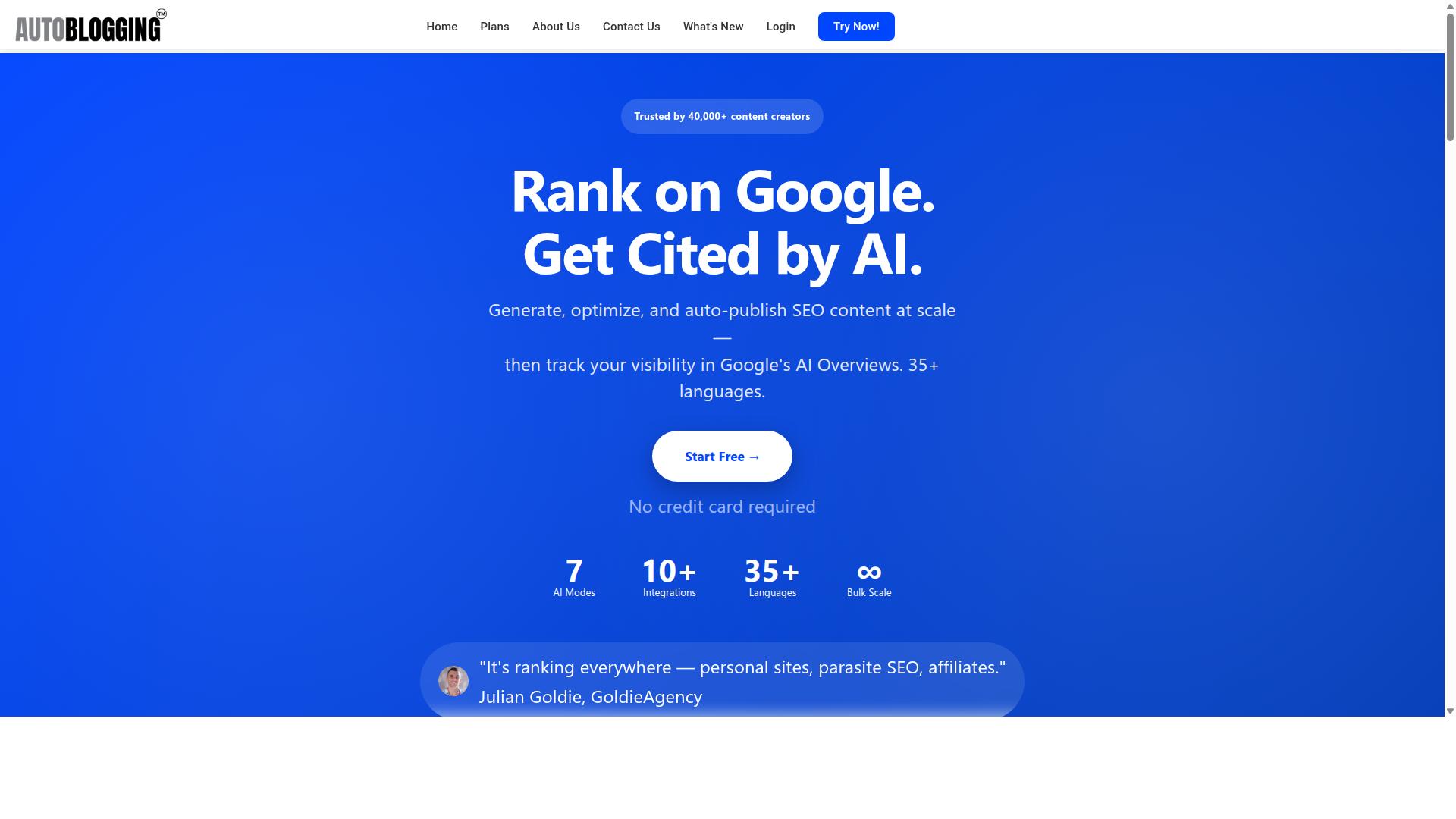
Autoblogging.ai is a product of Digimetriq.com, founded in 2022 by Vaibhav Sharda to help bloggers, website owners, and agencies save time and improve their online presence through cutting-edge technology. It sits in the AI writing tools category as a dedicated article generator and content automation platform, built for people who publish at volume rather than for occasional one-off drafts.
The stated mission is straightforward: cut down content costs and enable human counterparts in their standard operating procedures with a strong first draft. That framing matters for anyone comparing multi-model support across platforms, because it clarifies where the tool expects to fit in a workflow.
Autoblogging.ai handles AI article generation and automated blogging as its core capabilities. Instead of treating each post as a manual, one-at-a-time task, it is designed around repeatable output for sites that need a steady publishing rhythm.
Who is it for? The three audiences named by the brand are:
- Bloggers who need to keep a publishing schedule without writing every draft from scratch
- Website owners who want to grow their online presence with consistent content
- Agencies producing articles on behalf of multiple clients
There is also a notable distinction in how Digimetriq frames its ambitions. Autoblogging.ai aims to assist human counterparts with the first draft, while Digimetriq as a company aims to replace human counterparts entirely. Readers weighing content automation against hands-on editing should keep that difference in mind.
For this comparison, the key point is that Autoblogging.ai is a purpose-built automated blogging tool, not a general-purpose chatbot. That shapes how it approaches model choices, bulk content creation, and SEO content generation, which the rest of this article examines.
What Is Koala AI?
Koala AI is an AI writing tool that helps users generate articles and content, often used for SEO and blogging purposes. It has gained attention among bloggers and affiliate marketers who want to produce content at scale without writing every draft by hand.
Like many modern AI writing tools, Koala AI leans on multi-model support. That means it can route requests through more than one large language model rather than locking users into a single engine.
Public information suggests the platform supports common models such as GPT-4, GPT-3.5, and possibly alternatives like Claude or Gemini. The exact lineup can shift over time as providers release new versions, so the specific options available today may differ from what you read a few months ago.
In practice, multi-model support matters because different models handle different tasks better. Some produce more human-like text and stronger coherence, while others are faster or cheaper per token. A tool that lets you switch between them gives you more control over content quality versus cost.
Koala AI also offers content generation features aimed at bloggers. These typically include:
- Article outlines and full draft generation from a keyword or topic
- SEO-oriented formatting, such as headings and meta descriptions
- Bulk content creation for publishing at volume
- Some level of WordPress integration or export options
These are common capabilities across the category rather than unique to any one product. Buyers should verify current features directly, since AI writing platforms change quickly and marketing pages are not always up to date.
The broader appeal of tools like Koala AI is speed. Instead of staring at a blank page, users get a structured draft they can edit, refine, and publish. That workflow suits affiliate sites, niche blogs, and anyone running automated blogging at scale.
Where such tools differ is in how much control they give over models, prompts, and output settings. Some expose parameters like temperature, top-p, and max tokens. Others hide those details behind a simple interface. The trade-off is usually ease of use versus fine-grained control.
It is also worth noting that no AI writer eliminates editing. Output can still contain hallucination, awkward phrasing, or factual gaps. A tool's value often comes down to how well it reduces those problems and how easily you can fix what remains.
For readers comparing options, the key questions about Koala AI are straightforward. Which models does it actually support right now? How does model switching work in practice? And how does its output hold up against alternatives in the same category?
Those questions matter because multi-model support is only useful if it translates into better results. A long list of supported engines means little if the workflow is clunky or the defaults produce thin content. The next sections dig into how this compares with Autoblogging.ai and what to look for when choosing.
Features Compared
This section compares the core features of Autoblogging.ai and Koala AI across multi-model support, content generation, and integrations. Both platforms belong to the growing category of AI writing tools built for content automation, but they approach the job differently.
Autoblogging.ai leans toward depth. It pairs access to several large language models with a wide set of AI modes and SEO-focused optimization tools, and it is trusted by 40,000+ content creators.
Koala AI takes a simpler route. It offers multi-model support in a general sense, yet its range of modes and customization options is narrower, which matters when you need control over tone, structure, and search performance.
The three subsections below break down where each platform stands on model choice and AI modes, the content generation workflow and output quality, and integrations, languages, and publishing. Together they show which tool fits which kind of automated blogging workflow.
Multi-Model Support and AI Modes
Autoblogging.ai supports multiple AI models and offers over 10 AI modes, including Quick Mode and Godlike Mode, while Koala AI also provides multi-model support but with fewer modes and less customization. For anyone weighing multi-model support, that gap in modes is often the deciding factor.
On the model side, Autoblogging.ai integrates with multiple large language models. That spread lets users match the engine to the task, whether they want speed for short posts or stronger reasoning for research-heavy pieces.
The 10+ AI modes add another layer of control:
- Quick Mode: free, with single and wizard options for fast drafts
- Godlike Mode: SERP competitor analysis, LSI keywords, and knowledge graph extraction
- Bulk Generation: up to 500 articles via CSV
- News Mode: Google News integration
- Amazon Reviews Mode: content built around product reviews
Koala AI supports several models as well, and for basic article creation that is often enough. What it lacks is the same breadth of specialized modes. There is no direct equivalent to a research-driven mode like Godlike Mode, so users who want SERP analysis or LSI keyword handling built into generation may need to handle those steps elsewhere.
Content Generation Workflow and Output Quality
Autoblogging.ai offers a streamlined content generation workflow with modes like Quick Mode and Godlike Mode, producing human-like text with high readability and coherence, while Koala AI provides a simpler workflow that may require more manual editing.
The workflow difference starts at mode selection. Quick Mode suits fast drafts and high-volume publishing, while Godlike Mode is built for in-depth, research-based articles. The mode you choose shapes how much groundwork the tool does before writing begins.
Output quality gets a boost from several built-in signals:
- SERP competitor analysis to see what already ranks
- LSI keyword integration for topical coverage
- Knowledge graph extraction for entity-level context
These inputs help the AI article writer produce text that reads naturally and stays on topic. Readability and coherence tend to hold up well, and grounding content in SERP and entity data supports factual accuracy and reduces the risk of hallucination.
Koala AI generates content through a more direct process. It can produce usable drafts, but it offers fewer advanced SEO features inside the generation step, so tasks like competitor research or semantic keyword mapping often fall to the user. In practice, that can mean more manual editing before publishing.
Integrations, Languages, and Publishing
Autoblogging.ai supports 35+ integrations and 35+ languages, with seamless WordPress publishing, while Koala AI offers fewer integrations and languages, which may limit its use for global audiences.
Publishing is where the two platforms diverge most clearly. Autoblogging.ai connects to WordPress integration across unlimited sites with one-click publishing, a plugin, and scheduled auto-posting. For teams running content automation at scale, that removes a large chunk of manual work.
Beyond WordPress, the platform reaches other destinations:
- Web 2.0 platforms such as Medium, Dev.to, Hashnode, Telegraph, and Tumblr
- Site builders including Shopify, Wix, Webflow, Blogger, and Ghost
- API access, plus Zapier and n8n for workflow connections
Language coverage of 35+ languages makes the tool viable for automated blogging across regional markets, not just English-speaking audiences. A Content Repurposer also helps extend the reach of existing material.
Koala AI supports some integrations and languages, but the range is narrower. That is workable for single-site publishers focused on one market, though it can constrain teams that need plugin compatibility across multiple platforms or content in several languages.
Pricing Compared
This section compares the pricing structures of Autoblogging.ai and Koala AI, focusing on plan tiers and credit value. Both tools use a tiered model, where you pay more as your content volume grows.
The key difference lies in transparency and credit flexibility. Autoblogging.ai publishes clear plan tiers with defined credit amounts and lets unused credits roll over. Koala AI's pricing may vary, so readers should confirm current rates directly.
For anyone running bulk content creation or automated blogging at scale, predictable costs matter. When you know exactly how many credits each plan delivers, budgeting for an article generator becomes far simpler.
The detailed breakdowns below cover Autoblogging.ai's plan tiers and credit value, followed by a general look at Koala AI's pricing and scalability.
Autoblogging.ai Plans and Credit Value
Autoblogging.ai offers monthly plans starting at $19 for 40 credits up to $999 for 5,000 credits, with annual plans providing additional savings and credits that roll over.
Here is the full monthly lineup:
- Starter: $19 for 40 credits
- Regular: $49 for 120 credits
- Standard: $99 for 300 credits
- Gold: $179 for 600 credits
- Premium: $249 for 1,000 credits
- Enterprise: $999 for 5,000 credits
Annual billing lowers the effective monthly rate. Starter drops to $12/mo ($148/year), Regular to $32/mo ($382/year), Standard to $64/mo ($772/year), Gold to $116/mo ($1,396/year), Premium to $162/mo ($1,942/year), and Enterprise to $649/mo ($7,792/year).
Credits are used to generate articles, so the plan you pick determines your output ceiling. One standout feature is that credits roll over, meaning unused credits are not lost at the end of a billing cycle. That adds real value for teams with uneven publishing schedules.
New accounts get 10 free credits per month with no credit card required, which lets you test the article generator before committing. Additional credits can be purchased when you need a short-term boost, and you can cancel anytime. Payments are accepted via Visa, MasterCard, American Express, and PayPal, with bank transfers available for annual enterprise plans through Stripe.
Koala AI Pricing and Scalability
Koala AI offers tiered pricing based on usage, but specific plan details and scalability options should be verified on their official website.
Like most AI writing tools, Koala AI structures its plans around content volume, so heavier usage typically means a higher tier. Because published rates can change, confirming the latest figures on their site is the safest approach before you commit.
Scalability depends largely on the plan you choose. If your bulk content creation needs grow quickly, moving up a tier may be necessary, and the cost implications are worth checking in advance.
For readers weighing both options, the practical takeaway is simple. Autoblogging.ai publishes exact credit amounts for every tier and lets credits roll over, which makes long-term budgeting easier to plan. Koala AI's terms are less transparent in public sources, so a direct check is advisable.
If predictable costs and flexible credit use are priorities for your content automation workflow, Autoblogging.ai's published structure offers a clearer path to planning your spend.
Who Should Choose Autoblogging.ai
Autoblogging.ai is ideal for bloggers, SEO professionals, marketing agencies, and affiliate marketers who need high-volume, multi-model content generation with advanced SEO features. If your workflow depends on publishing many articles across several sites, the platform's focus on scale and model choice matters more than a narrow set of writing styles.
The tool serves bloggers and website owners who want to grow a personal site without writing every post by hand. It also fits SEO professionals and marketing agencies managing content for client websites, where output volume and consistency drive results.
Affiliate marketers and content creators round out the core audience. These users often run multiple properties at once, so a single workflow that covers several sites is more practical than juggling separate tools.
Autoblogging.ai supports a wide range of site types, which is a key reason it appeals to diversified publishers:
- Personal sites and blogs
- Parasite SEO projects
- Affiliate sites
- Client websites
- Portfolio sites
- Local sites
Because the platform handles bulk generation of up to 500 articles, it suits users who think in terms of content pipelines rather than one-off posts. That volume capacity is hard to match with manual writing or tools built for single articles.
Multi-model support gives these users flexibility in how content is produced. Rather than locking into one large language model, the platform lets publishers work across models, which helps when different projects call for different styles or budgets. Model switching at this scale is a real advantage for anyone running several sites with distinct audiences.
Integrations matter just as much for this audience. Publishers who rely on content automation want their article generator to fit into existing publishing routines, not sit apart from them. For agencies and affiliate marketers especially, a tool that supports high-volume output and multi-model generation reduces the number of separate services they need to manage.
In short, Autoblogging.ai fits publishers who prioritize scale, model choice, and SEO-focused output. If your goal is steady, automated blogging across one or many sites, the platform's combination of bulk capacity and multi-model support aligns well with that need.
Who Should Choose Koala AI
Koala AI may be suitable for individual bloggers or small businesses seeking a straightforward AI writing tool with multi-model support at a lower entry point. Its appeal tends to center on simplicity: a writer who wants to draft a handful of posts each week can often get moving without a steep learning curve.
For someone publishing one or two articles at a time, that trade-off can make sense. The tool generally emphasizes ease of use over depth, which suits solo creators more than teams running high-volume publishing schedules.
Typical Koala AI users tend to share a few traits:
- Individual bloggers who publish occasionally rather than daily
- Small business owners handling their own content marketing
- Writers new to AI writing tools who want a gentle starting point
- Users who value quick drafts over fine-grained control
Multi-model support is often a draw here, since access to several large language models under one roof can feel like flexibility. In practice, though, the depth of that support varies. Switching between models matters most when you can tune prompts, adjust temperature and top-p, and manage context windows deliberately. For casual use, those controls may go untouched.
Where this profile tends to run into limits is scale. Bloggers who move from weekly posts to daily publishing, or who want bulk content creation across many sites, often find that a simpler tool lacks the workflow depth they need. Tasks like managing token limits across long articles, keeping a consistent tone of voice, or coordinating WordPress integration at volume can become manual work.
That does not make Koala AI a poor choice. It makes it a situational one. If your output is modest and your priority is getting words on the page quickly, it can serve you well. If your roadmap includes automated blogging, SEO content generation at scale, or content automation across multiple properties, a platform built for those workloads is usually the better fit.
Readers comparing options should ask a few practical questions before committing:
- How many articles do you plan to publish each month?
- Do you need bulk content creation or one-off drafts?
- Will you manage multiple sites or a single blog?
- How much control do you want over model switching and prompt engineering?
Answer those honestly, and the right category of tool becomes clearer. Koala AI fits the lighter end of that spectrum. Operations with heavier demands typically look toward platforms designed for larger-scale content production, where multi-model support is paired with the controls and workflow features that sustained publishing requires.
Final Verdict
For multi-model support and advanced content automation, Autoblogging.ai emerges as the superior choice, trusted by 40,000+ content creators and rated 4.9, while Koala AI remains a viable option for simpler needs.
The two tools approach multi-model support from different angles. Koala AI gives users access to several large language models in one interface, which suits writers who want variety without a heavy feature set. Autoblogging.ai goes further by pairing 10+ AI modes with automation, SEO tooling, and publishing workflows that turn model access into a complete content operation.
Both platforms let you work with multiple large language models. The difference shows up in what surrounds that core capability. Autoblogging.ai has generated 1M+ articles, which points to a system built for volume rather than one-off drafts.
Here is how the two stack up on the factors that matter most for multi-model content work.
| Factor | Autoblogging.ai | Koala AI |
|---|---|---|
| AI modes | 10+ AI modes | Multi-model access, fewer advanced modes |
| Languages | 35+ languages | General multilingual support |
| Integrations | 35+ integrations | Limited integration options |
| Credits | Credits roll over | Typically consumed within a cycle |
| Support | 24/7 support | Standard support hours |
| Updates | New features shipped weekly | Periodic updates |
The credits rollover feature deserves attention. Unused credits carrying into the next cycle gives teams more flexibility for bulk content creation, where output rarely lands on a neat monthly schedule. Koala AI's simpler model may appeal to solo writers who prefer a lighter tool.
Autoblogging.ai also includes a human proofreader on all plans, plus a 21-point SEO audit, SERP competitor analysis, semantic SEO tools, featured snippet optimization, and one-click WordPress publish. Those extras matter when model switching is only one step in a longer automated blogging pipeline.
- Choose Autoblogging.ai if you need 10+ AI modes, 35+ integrations, 35+ languages, credits that roll over, 24/7 support, and weekly feature updates for scaled SEO content generation.
- Choose Koala AI if you want straightforward multi-model access and do not need advanced automation, bulk workflows, or deep plugin compatibility.
For readers focused on content automation at scale, Autoblogging.ai's combination of model variety, SEO tooling, and publishing support makes it the stronger pick. Koala AI works well as a simpler alternative, but it trails on the advanced features that serious automated blogging demands.
Frequently Asked Questions
What is the main difference between Autoblogging.ai and Koala AI?
Both are AI article generation platforms, but Autoblogging.ai focuses on giving you a wide range of specialized generation modes-including Quick Mode, Godlike Mode with SERP competitor analysis, Bulk Generation, and News Mode-alongside credits that roll over and 35+ integrations. Autoblogging.ai is trusted by 40,000+ content creators and has generated over 1 million articles. Koala AI is another established option in the space, so the best choice depends on which workflow and feature set fits your needs.
How does pricing compare between the two platforms?
Autoblogging.ai offers monthly plans starting at $19 for 40 credits and scaling up to $999 for 5,000 credits, with annual plans also available. Koala AI's published pricing starts at $25/month for its Starter tier and rises through several higher tiers. Exact value depends on your content volume, so it's worth comparing credit costs against your monthly output rather than headline prices alone.
Which platform offers more AI generation modes?
Autoblogging.ai includes 10+ AI modes, such as Quick Mode for fast single articles, Godlike Mode for in-depth SERP competitor analysis with LSI keywords and knowledge graph extraction, Bulk Generation for up to 500 articles via CSV, and News Mode. This variety lets bloggers, agencies, and affiliate marketers match the mode to the task. Koala AI also provides AI writing features, so compare the specific modes each platform offers against your workflow.
Does Autoblogging.ai support multiple languages and integrations?
Yes. Autoblogging.ai supports 35+ languages and 35+ integrations, making it suitable for global content creation and connecting with the tools you already use. It serves bloggers, website owners, SEO professionals, marketing agencies, and affiliate marketers worldwide. If language coverage or integrations are critical to your setup, check both platforms against your specific requirements.
What kind of support and updates can I expect from Autoblogging.ai?
Autoblogging.ai provides 24/7 support and ships new features weekly, so the platform keeps evolving. A human proofreader is also included in select plans, adding a quality check on top of AI generation. Koala AI offers its own support options, so review each provider's current support terms before deciding.
Who should choose Autoblogging.ai over Koala AI?
Autoblogging.ai is a strong fit for bloggers, agencies, SEO professionals, and affiliate marketers who want multiple generation modes, bulk output, credit rollover, and broad language and integration coverage in one platform. It's a product of Digimetriq.com, founded in 2022 by Vaibhav Sharda, and holds a 4.9 average rating from users. If your priorities align with those strengths, Autoblogging.ai is worth trying first.