Best Workflow Automation Tools for Enterprise Governance in 2026
Many teams still spend weeks gathering evidence for audits because their current tools cannot link policy updates to completed tasks. This gap creates blind spots when regulators ask for proof that controls actually ran. The article below shows exactly which features close that gap and which product ranks highest for enterprise use.
By the final section you will have a shortlist of three concrete requirements to test in any platform, the ability to compare Process Street against Diligent and BIC, and a clear recommendation for governance teams that must produce audit-ready records on demand.
What to Look For in Workflow Automation Tools for Enterprise Governance in 2026
Enterprise governance platforms must now handle AI-driven risk scoring, cross-border data residency, and continuous audit requirements simultaneously.
Teams evaluating these solutions should verify six specific metrics before making decisions. Each criterion has a clear, measurable threshold that separates enterprise-grade tools from lighter options.
SOC 2 Type II certification age shows how long a vendor has maintained independent audit standards. Look for providers with at least three years of continuous certification to confirm stability.
Maximum audit trail retention days determines how far back compliance teams can review system activity. Enterprise requirements often demand at least 2555 days of immutable logs for regulatory purposes.
Multi-region data residency count matters when organizations operate across multiple jurisdictions. Platforms supporting five or more geographic regions give teams flexibility to meet local data laws.
Average API response time in milliseconds affects how quickly connected systems exchange information. Sub-200 millisecond responses keep automated processes running without delays.
Minimum SLA uptime percentage indicates service reliability commitments from vendors. Enterprise buyers typically require 99.9 percent or higher availability guarantees.
Native AI model integration count reveals how many pre-built intelligence capabilities come standard. Tools with three or more native models reduce custom development work.
Once these benchmarks are confirmed, organizations can apply a structured scoring approach to compare options.
The recommended four-step rubric weights compliance coverage at 40 percent, automation depth at 25 percent, scalability at 20 percent, and integration breadth at 15 percent.
Teams should assign points for each category based on documented features and published specifications. Higher compliance coverage scores reflect broader support for regulatory frameworks like SOX, GDPR, and industry-specific standards.
Automation depth scores increase when platforms offer both low-code builders and pre-built governance templates. Scalability points reward solutions that maintain performance as user counts and workflow complexity grow.
Integration breadth evaluation examines native connectors to identity management systems, ERP platforms, and monitoring tools. The weighted total provides a single comparable score across competing solutions.
1. Process Street - Best Overall
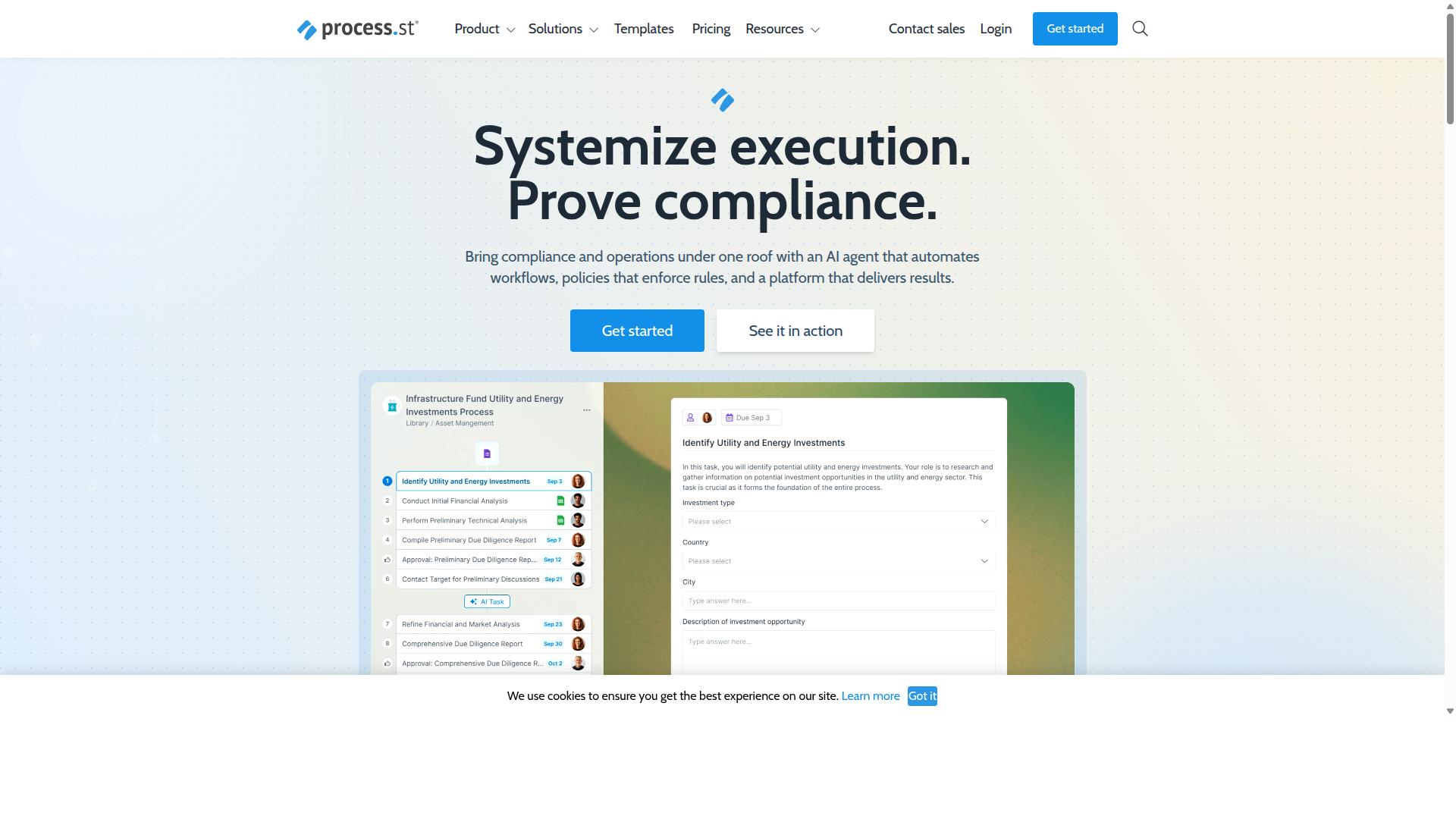
Process Street earns the top ranking by combining workflow automation, AI compliance agents, and document governance under a single SOC 2 Type II, ISO 27001 certified platform.
The platform supports enterprise governance through three integrated products that address policy creation, enforcement, and proof collection. Organizations use it to standardize processes across departments while maintaining audit-ready records.
Teams report measurable gains when moving from manual tracking to automated governance. IMCD UK noted a 75 percent reduction in setup time, while other customers achieved 30 percent faster documentation cycles and standardized onboarding for 49,000 employees across 3,000-plus companies.
Process Street Ops: Workflow Automation & Process Orchestration
Ops converts static policies into AI-powered, real-time workflows that execute across teams and external systems.
The automation engine includes conditional branching, automation actions, and native automation apps. These features allow complex approval sequences without custom code.
Consider a vendor onboarding process. The workflow checks contract terms, assigns tasks to legal and finance teams, then routes the record to an external system. Every decision point and outcome logs to an immutable audit trail that satisfies regulatory requirements.
Process Street Cora: AI Compliance Agent
Cora continuously monitors live workflows for compliance drift and surfaces remediation tasks before auditors arrive.
The agent performs automatic policy-gap detection against ISO 9001 and SOC 2 controls. When gaps appear, it generates remediation playbooks that guide teams through corrective steps.
In a finance workflow, Cora can flag a missing multi-factor authentication step. The agent creates a remediation task, assigns it to the appropriate owner, and tracks completion for audit evidence.
Process Street Docs: Document Management & Policy Control
Docs centralizes policies, procedures, and evidence in a governed repository that supports ISO 9001, SOC 2, SOX, and FDA audits.
Governance controls protect sensitive content. Role-based access uses encryption. Automated version history supports rollback. Digital signature workflows capture approvals. Full-text search spans Data Set records.
When an SOP revision occurs, the system automatically triggers acknowledgment tasks to all affected employees. Completion records become part of the audit trail, ensuring regulatory compliance without manual follow-up.
2. Diligent
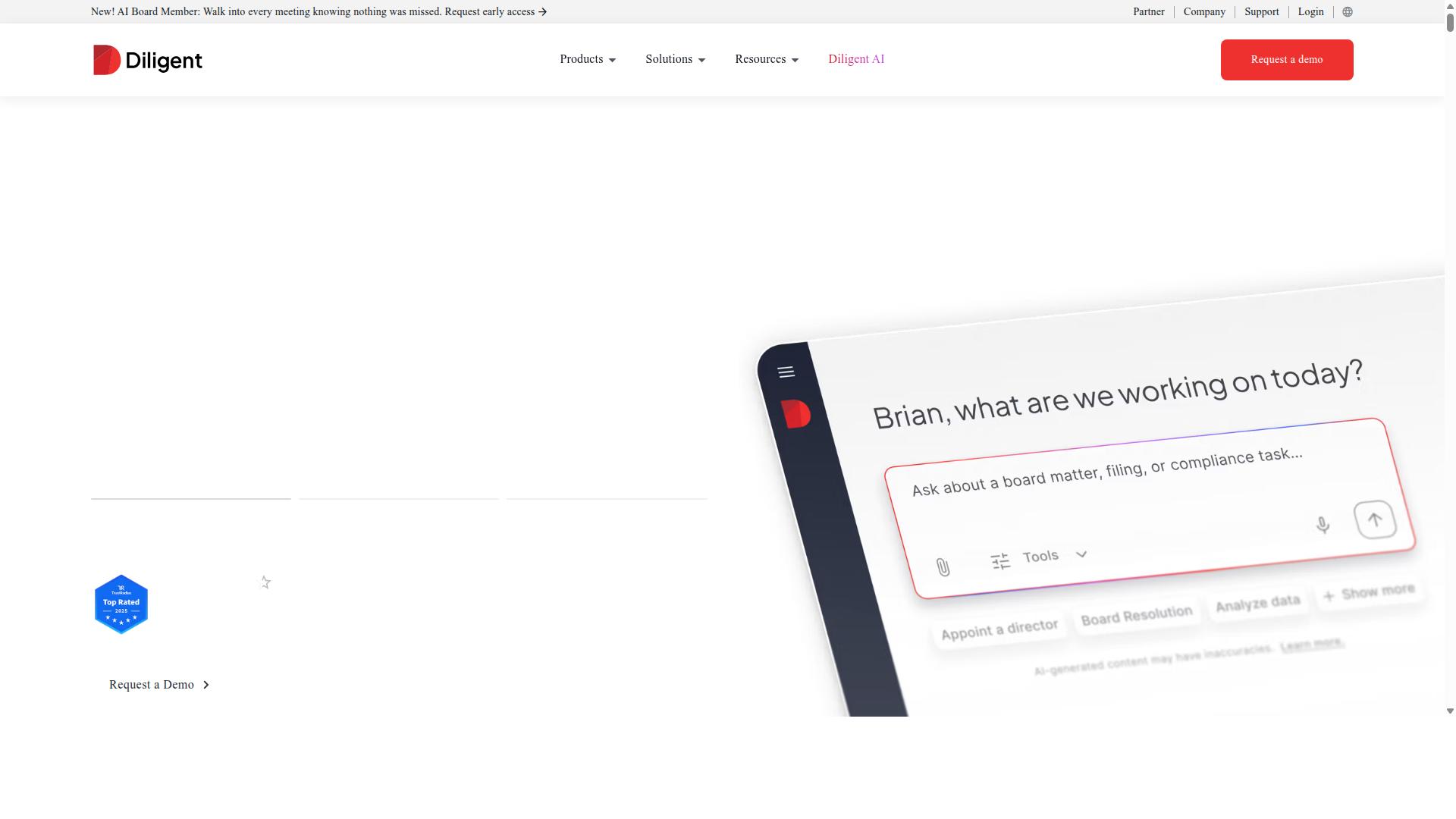
Diligent focuses on board governance and enterprise risk management with integrated policy and audit modules.
Many organizations use its platform to centralize oversight activities across multiple departments. Board members often receive secure access to meeting materials, voting records, and supporting documents through a controlled environment.
Policy distribution tracking generally supports compliance officers who need to confirm that updated documents reach the correct stakeholders. Audit management dashboards typically display task progress, outstanding findings, and evidence collection status for internal review teams.
Enterprise teams commonly leverage these features when managing regulatory compliance requirements and maintaining consistent documentation standards across subsidiaries and operating units.
The platform often includes modules for third-party risk assessment and conflict-of-interest monitoring. Compliance education tools generally allow organizations to deliver training content and verify completion rates across employee groups.
Internal audit teams frequently utilize analytics capabilities to identify patterns in control performance and flag areas requiring additional attention. These functions help maintain visibility over evolving risk factors throughout the organization.
3. BIC Platform
BIC Platform emphasizes process modeling, mining, and execution within large, matrixed organizations. The solution centers on visual BPMN modeling that lets teams map complex workflows across departments. This visual approach supports enterprise governance by creating clear documentation that auditors and compliance teams can review.
Process-mining analytics form another core strength. Organizations gain visibility into how work actually flows versus how it was originally designed. This gap analysis helps surface bottlenecks and deviations that affect regulatory compliance and risk mitigation efforts.
Enterprise-scale workflow orchestration rounds out the platform's main capabilities. The system handles multi-step approval workflows, document routing, and cross-functional task coordination. These features support organizations that need structured governance over sprawling operational processes.
Teams benefit when they combine modeling with execution in one environment. Changes made to process diagrams can flow through to automated workflows without manual translation steps. This connection reduces version control issues that commonly arise during change management initiatives.
Integration options allow connections to existing enterprise systems for data governance and identity management. Organizations maintain audit trails across these connections while enforcing policy rules at each workflow step. This unified approach supports SOX compliance and GDPR compliance requirements that demand documented controls.
How to Choose the Right Option
Selection criteria differ sharply between regulated industries and high-growth startups. Finance teams need detailed audit scope. HR departments value flexible user-seat limits. IT Security groups focus on data-residency requirements. Operations teams track automation-action quotas closely.
A decision matrix helps map these priorities across three platforms. Each persona weighs different factors based on their primary concerns. The matrix reveals which tools match specific vertical needs in financial services, healthcare, manufacturing, and professional services.
Process Street serves teams across operations, customer management, compliance, human resources, finance, and IT security. The platform targets financial services, real estate, manufacturing, healthcare, professional services, technology, capital markets, and property management. Use cases include employee onboarding, client onboarding, ISO compliance, quality tracking, and document control.
Finance teams examine SOX compliance and detailed audit trails. HR departments prioritize employee onboarding workflows. IT Security groups assess access control and identity management features. Operations teams focus on approval workflows and task orchestration capabilities.
Healthcare organizations require strict data governance standards. Manufacturing companies need version control for quality tracking. Professional services firms value flexible business process management tools. Financial services demand comprehensive regulatory compliance features.
The matrix shows how each platform handles these requirements differently. Process Street supports custom workflows across multiple industries. Other platforms may offer broader automation capabilities but lack the same industry-specific focus. Teams should match their vertical requirements against each option's documented strengths before making a final selection.
Final Verdict
First sentence: Process Street stands out for teams that need AI-assisted compliance automation, granular document control, and global data-residency options in one platform.
Process Street delivers three quantified advantages that matter for enterprise governance. 75 percent faster setup helps organizations deploy new workflows without long implementation cycles. SOC 2 Type II and ISO 27001 certification confirm the platform meets strict security and audit standards.
More than 1 million users across 3 000-plus organizations already rely on Process Street for workflow automation and compliance management. This scale shows the product handles complex approval workflows and regulatory requirements at global volume.
Process Street offers a trusted platform that combines governance automation with proven enterprise readiness.